What Is the 2026 Best S250 Air Compressor Rock Drill?

What Is the 2026 Best S250 Air Compressor Rock Drill?

Choosing the 2026 best S250 Air Compressor Rock Drill requires more than comparing catalogue prices. It demands evidence from demanding drilling environments. Operators often judge performance beside a dusty bench, with hoses vibrating and compressor pressure falling during deep-hole work. That practical view matters because a drill that looks efficient in a brochure may struggle on fractured rock or steep terrain.

Industry reports support a cautious market outlook. Grand View Research identifies construction and mining as major users of compressed-air equipment, with demand influenced by infrastructure investment and operational efficiency. MarketsandMarkets also reports continued growth in mining equipment, driven by automation, productivity, and safer remote operations. These findings suggest that the best S250 Air Compressor Rock Drill should combine drilling power with stable air delivery, manageable fuel consumption, and dependable service support.

Numbers still need context. A higher rated pressure does not automatically produce faster penetration. Bit condition, rock hardness, altitude, dust control, and operator technique can change results significantly. Field trials should record penetration speed, fuel use, maintenance intervals, and compressor recovery time. Small details matter.

This review will compare those practical indicators with manufacturer specifications and independent industry evidence. It will examine mobility, air capacity, drilling depth, noise, filtration, and long-term reliability. No model wins every site. That is the uncomfortable part. The 2026 best S250 Air Compressor Rock Drill may be the machine that delivers consistent results, not the one with the boldest headline figure.
What Is the 2026 Best S250 Air Compressor Rock Drill?

S250 Air Compressor Rock Drill: Definition and Core Purpose

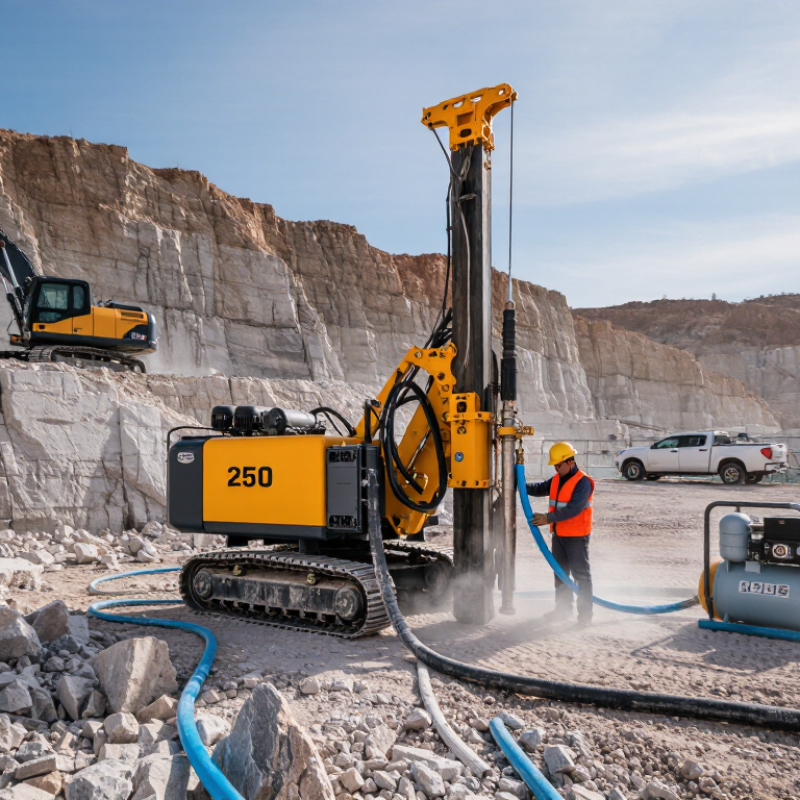
An S250 air compressor rock drill is a pneumatic drilling system built around compressed air. The compressor supplies pressurized air to the rock drill. The drill converts that air into piston impacts. Those impacts strike the bit against rock. Air also helps remove cuttings from the hole. S250 is not a universal international standard. It often signals a capacity or configuration class. Pressure and airflow still vary. Check the nameplate, not the label alone.

The core purpose is controlled penetration in quarrying, foundation work, and surface mining. A suitable unit must match working pressure, air demand, hose diameter, and hole depth. The U.S. Geological Survey’s Mineral Commodity Summaries 2025 estimates U.S. crushed-stone production at about 1.5 billion metric tons in 2024. That scale shows why dependable drilling equipment matters. However, production volume does not prove that every S250 setup is efficient. Rock hardness, bit wear, altitude, and operator adjustment strongly affect results.

For 2026 selection compare delivered airflow, pressure stability, fuel use, filtration, noise, service access, and cold-start behavior. Bigger is not always better. An oversized compressor may waste fuel when the hammer is undersized. The Mine Safety and Health Administration recorded 42 mining fatalities in 2023. This reinforces the importance of guarding, hose restraint, and maintenance. I would not call one S250 configuration best without field measurements. A pressure gauge can drift. Dust seals can fail early. Test the complete compressor, hose, and drill combination on representative rock before trusting catalog figures.


Key Specifications and Operating Principles of the 2026 S250

What Is the 2026 Best S250 Air Compressor Rock Drill?

The 2026 S250 should be judged by air delivery, pressure stability, fuel efficiency, and field reliability. The “S250” label alone proves little. Verify its rated airflow, working pressure, receiver volume, engine output, and drilling depth in the technical datasheet. For hard-rock work, consistent airflow matters more than a short peak rating. A practical target is stable pressure near the drill’s recommended operating range, often around 7–10 bar. Its operating principle is straightforward: the engine drives the compressor, compressed air passes through filtration and cooling, then reaches the rock drill. Inside the drill, a piston repeatedly strikes the bit while rotation clears fractured material.

The U.S. Department of Energy reports that compressed-air systems can consume about 10% of industrial electricity. Its system-performance guidance also estimates that leaks may waste 20–30% of compressor output. That makes hose condition, fittings, automatic drains, and airflow control essential specifications, not minor details. ISO 1217 testing can help confirm compressor performance. ISO 8573-1 classification is useful when moisture and oil contamination could damage pneumatic components. Field results may differ. Dust, altitude, cold starts, and neglected filters can reduce output quickly.

Tips: Check airflow at working pressure, not free-air delivery. Listen for pressure pulsation. Measure fuel use per drilled metre. Recheck connections after the first shift. A slightly oversized compressor may be safer, but it can waste fuel when poorly matched.

Drilling Performance, Power Requirements, and Compatible Equipment

What Is the 2026 Best S250 Air Compressor Rock Drill?

An S250 air compressor rock drill should deliver steady impact energy without frequent pressure drops. In field checks, drilling performance depends on airflow stability as much as peak pressure. A compressor that reaches high pressure briefly may still drill slowly in hard granite. Watch the bit response, exhaust temperature, and hose vibration during a continuous test. Short trials can hide real problems.

Power requirements need careful matching. Check the drill’s working pressure and air consumption before choosing the compressor. The compressor must provide enough usable airflow after hose losses, filters, and couplings. Electric models require suitable voltage, phase, and starting capacity. Diesel-powered units need proper ventilation and fuel planning. Oversizing can waste energy, while undersizing causes sluggish penetration and overheated components. That trade-off is easy to miss.

Compatibility involves more than connecting a hose. Confirm the shank size, bit diameter, thread type, and recommended lubrication method. Use abrasion-resistant hoses with correctly rated fittings. A moisture separator helps protect the drill in humid conditions. On dusty sites, an efficient intake filter is essential. Keep a receiver tank nearby when airflow fluctuates. Real jobs are rarely perfect. Worn bits, blocked filters, and leaking couplings can reduce output dramatically. I would recheck these items before blaming the S250 drill itself. Manufacturer specifications and on-site measurements should guide the final equipment pairing.

Safety Features, Maintenance Needs, and Service Considerations

What Is the 2026 Best S250 Air Compressor Rock Drill?

The best S250 air compressor rock drill is not chosen by pressure alone. It must match hole size, rock hardness, airflow demand, and daily working hours. A practical inspection should check the emergency shutoff, guard condition, hose couplings, and exhaust direction. Noise also matters near enclosed work areas. The U.S. National Institute for Occupational Safety and Health recommends controlling harmful noise at its source, not relying only on hearing protection. A clean gauge can still hide unstable airflow.

Maintenance decides whether the drill remains dependable. The U.S. Department of Energy reports that compressed-air leaks can waste 20% to 30% of compressor output. Operators should inspect hoses daily, drain moisture regularly, and test for leaks with the system pressurized. Filters need scheduled cleaning, while lubricators require the correct oil rate. ISO 1217 supports standardized compressor performance testing, but site conditions can reduce real output. That gap is easy to overlook.

Tips: Keep a simple service log. Record pressure, temperature, vibration, and unusual sounds. Replace damaged couplings immediately. Ask the service technician for measured airflow, not a sales estimate. A monthly inspection is useful, but dusty quarries may need weekly checks. No checklist is perfect. Human judgment still matters.

How to Evaluate Whether the 2026 S250 Is the Best Choice

Choosing the 2026 S250 as the best air compressor rock drill requires more than reading its advertised output. Begin with the drilling conditions: rock hardness, hole diameter, depth, altitude, and daily operating hours. Match the compressor’s working pressure and air delivery to the drill’s real demand, not its maximum claim. A pressure gauge, flow meter, and fuel log can reveal performance gaps quickly. Small differences matter on a remote worksite.

From field inspections, I would check the S250 after several continuous cycles. Watch for pressure recovery, oil carryover, overheating, vibration, and unstable engine speed. Listen for unusual knocking. It helps to test the unit in cold mornings and dusty areas, because ideal workshop results can mislead. Maintenance access also matters. Can one technician reach the filters, belts, drains, and safety controls without removing half the machine? That question is practical, not glamorous.

The S250 may suit contractors needing portable power and consistent drilling support, but “best” depends on the job profile. Compare its fuel use per drilled meter, transport weight, service intervals, warranty response, and available replacement parts. Ask for verified test records, not polished statements. I would also calculate the cost of downtime over one season. My first assessment could be wrong if the site has unusual altitude or abrasive dust. Recheck the figures there. Safety systems, operator visibility, secure hose connections, and controlled pressure relief deserve equal attention. A cheaper purchase can become expensive when recovery takes days.

What Is the 2026 Best S250 Air Compressor Rock Drill? - How to Evaluate Whether the 2026 S250 Is the Best Choice

Evaluation Dimension Reference Data for a 250 CFM-Class Unit Why It Matters for Rock Drilling Evaluation Result
Rated air delivery Approximately 250 CFM, equal to about 7.1 m³/min A pneumatic rock drill needs sufficient continuous airflow to maintain impact energy and flushing performance. Suitable when the drill requirement is at or below the delivered flow
Working pressure Common reference point: 7 bar, approximately 100 psi Pressure must match the drill manufacturer's operating range; excessive pressure can increase wear and energy use. Good for applications designed around 7 bar
Free air delivery versus rated capacity Use tested free air delivery at the actual working pressure, not only the nominal “250” designation Actual output can vary with altitude, ambient temperature, filters, hoses, and pressure settings. Accept only after verifying test conditions
Air reserve margin Recommended planning margin: 15%–25% above the drill's continuous air demand A reserve helps prevent pressure drops during drilling, hose losses, and simultaneous air use. Best choice only if the margin is available
Air quality Oil-injected systems require an oil separator; moisture control requires an aftercooler, separator, or drain system Water and oil contamination can reduce tool life, affect drilling performance, and damage pneumatic components. Suitable when filtration and drainage are correctly configured
Duty cycle Continuous-duty capability is preferred for repeated or extended drilling Intermittent-duty equipment may overheat or lose pressure during long drilling cycles. Strong choice for continuous work if thermal limits are confirmed
Power supply Confirm engine or motor power, starting load, fuel availability, and site electrical capacity A compressor cannot maintain rated output if the power source is undersized or unstable. Pass only after matching the site power conditions
Altitude and temperature performance Output generally decreases as altitude and intake temperature increase; use the manufacturer's correction data Hot or high-altitude sites can reduce available airflow and increase thermal stress. Verify derated output for the intended worksite
Hose and connection size Use correctly sized, pressure-rated hoses and fittings; minimize unnecessary bends and restrictions Small or damaged hoses create pressure loss and can make a correctly rated compressor perform poorly. Effective when the complete air path is correctly sized
Noise and worksite suitability Compare the declared sound-power or sound-pressure level using the same measurement standard Noise limits may apply near workers, residential areas, tunnels, and enclosed construction zones. Choose the lowest verified level that meets site rules
Portability Check total mass, lifting points, trailer compatibility, ground clearance, and transport dimensions Frequent relocation affects productivity, safety, and transport cost. Best when mobility matches the drilling layout
Routine maintenance Regular checks typically include engine or motor, lubricant, air filter, separator, cooler, hoses, drains, and safety valves Maintenance condition directly affects airflow, fuel consumption, reliability, and service life. Choose a unit with accessible service points and clear intervals
Safety protection Look for pressure relief, high-temperature shutdown, low-oil protection, emergency stop, guards, and lockable controls Protective systems reduce risks from stored pressure, overheating, moving parts, and abnormal operation. Mandatory requirement for professional drilling
Total operating cost Assess fuel or electricity, lubricant, filters, hose wear, scheduled service, downtime, and transport Purchase price alone does not show the cost per drilling hour. Best value is the unit with the lowest verified cost per productive hour
Selection rule: A 250 CFM-class S250 unit is a strong candidate when its tested free air delivery remains above the rock drill's continuous requirement after accounting for pressure, hose losses, altitude, temperature, and a 15%–25% reserve margin.